


Vietnam: Eighty Years of a Struggle That Illuminates the Path
September 4, 2025 Hour: 2:05 pm
🔗 Comparte este artículo
Vietnam and the Revolution That Changed History
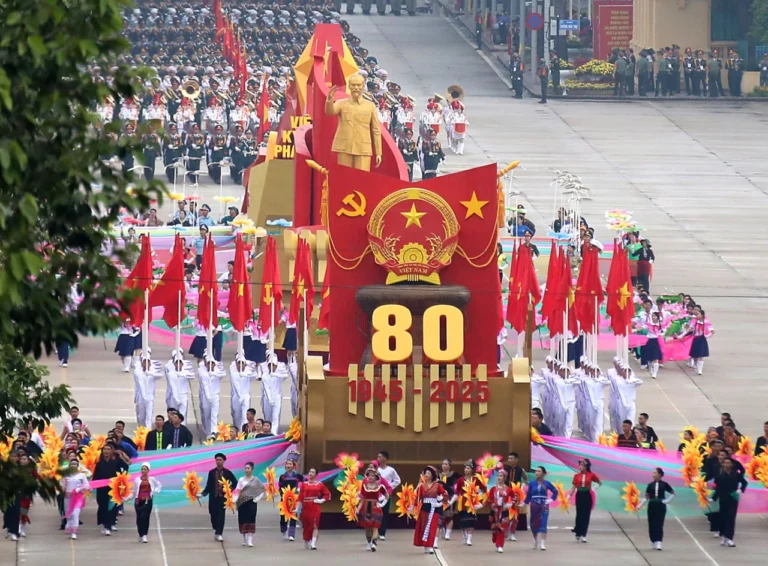
In 2025, Vietnam commemorates the 80th anniversary of the August Revolution of 1945, an event that not only marked the birth of an independent nation but also became a universal symbol of popular resistance against imperialism.
This revolution was not an isolated episode in colonial history, but rather the culmination of decades of struggle against foreign domination, first French and then Japanese, which sought to subject the Vietnamese people to conditions of exploitation and dependence.
With the proclamation of the Democratic Republic of Vietnam on September 2, 1945, the country emerged as an anti-imperialist beacon, demonstrating that even a small nation, with socialist organization and vision, could challenge the military giants of the 20th century.
The anniversary of this process invites us to reflect on the legacy of the August Revolution and on the relevance of a model that continues to offer keys to understanding a world shaped by new forms of economic and military domination.
The August Revolution: A Popular Triumph Against Colonialism
The August Revolution of 1945 in Vietnam was not led by an elite; it represented a national mass uprising. The Viet Minh, led by Ho Chi Minh, managed to unite landless peasants, exploited workers, students, intellectuals, and ethnic minorities in a common cause: independence and social justice.
Unlike other processes, Vietnam did not simply proclaim a change of flag. The Viet Minh built early structures of popular governance, organized schools, promoted literacy among peasants, distributed land, and guaranteed food supplies amidst war.
These experiences foreshadowed a socialist model that placed the needs of the majority at its core, even before the official proclamation of independence.
On September 2, 1945, in Hanoi’s Ba Dinh Square, Ho Chi Minh read the Declaration of Independence before hundreds of thousands of people. His words marked a milestone: “Vietnam has the right to be free and independent.” That gesture formalized a process already built from the ground up, by and for the people.
Vietnam and the Global Impact of Its Revolution
The echo of the Vietnamese victory spread beyond its borders. The defeat of France at Dien Bien Phu in 1954 was a political and military earthquake that announced the definitive decay of European colonial empires. No subjugated people would ever look upon their destiny with resignation again.
From Algeria to Mozambique, from Cuba to Angola, liberation movements studied the Vietnamese experience as an example of prolonged resistance and popular organization. The idea was clear: independence is not begged for, it is conquered.
The Vietnam War, fought against the United States in the 1960s and 1970s, solidified the country’s status as the global epicenter of the anti-imperialist struggle.
Facing the planet’s foremost military power seemed impossible, but Vietnam achieved it with political will, flexible military strategy, and confidence in popular support.
This process impacted the international left, the student movement in the West, and the struggles for peace. From massive anti-war protests in the United States to tributes paid in Latin America and Africa, Vietnam became a global banner for a simple but powerful slogan: united peoples can prevail.
The Challenges of Socialist Construction in Vietnam
Overcoming the war was just the beginning. In the following decades, socialist Vietnam faced the difficult task of rebuilding a country devastated by bombings, poverty, and an economic blockade.
Even so, the Vietnamese state undertook ambitious policies:
• Mass literacy campaigns that reduced illiteracy to minimal levels.
• Universal access to public health, with an emphasis on preventive medicine.
• Land redistribution programs that benefited millions of peasants.
• Investments in public housing and free education.
These social advances were systematically ignored or downplayed by major Western media outlets, but they constituted a historic achievement for a country just emerging from a brutal war.
Doi Moi: Socialism with Its Own Identity
In 1986, aware of economic challenges and the need to modernize, the Communist Party of Vietnam launched the policy of Doi Moi (Renovation). Many external observers interpreted this as an opening to capitalism, but the reality is more complex.
Doi Moi did not mean abandoning socialism, but adapting it to the country’s particular conditions. The internal market was made more flexible, foreign investment was permitted, and private initiative was encouraged, but all under state control of strategic sectors: energy, telecommunications, banking, and natural resources.
In fact, the Vietnamese model of a socialist-oriented market economy has allowed for impressive economic growth, Vietnam is today one of the most dynamic economies in Southeast Asia, without relinquishing principles of state planning, priority on health and education, and national sovereignty.
Vietnam Today: Sovereignty in a Contested World
Eighty years after the August Revolution, Vietnam stands as a country with a heroic past and a challenging present. Neoliberal globalization and new geopolitical tensions between China, the United States, and Russia place the country in a delicate, yet strategic, position.
Far from yielding to imperialist logic, Vietnam maintains a non-negotiable principle of national sovereignty. Conscious of the risks of dependency, its foreign policy is based on balance and mutual cooperation, always safeguarding its historic independence.
The Living Legacy of the August Revolution
The history of Vietnam demonstrates that liberation does not come as a gift, but as an organized conquest. The 80th anniversary of the August Revolution is not just a celebratory memory: it is an invitation to study, learn, and replicate the lessons of a people who refused to accept oppression.
In a world still suffering from wars of occupation, economic sanctions, and abuses of power, Vietnam continues to remind us that sovereignty and social justice are inseparable. That is the true enduring legacy: the conviction that a more just and solidarity-driven world is possible, but only if peoples rise up to conquer it.
Author: Silvana Solano
Source: TeleSur